Maty Biayenda: After Hours
Exhibition text by curator Martha Kirszenbaum for the public exhibition Maty Biayenda: After Hours
Maty Biayenda deploys a kaleidoscope of aesthetic experiments spanning painting, drawing, textiles, sculpture, video, and immersive installations. Deeply imbued with impressionist sensibilities and semi-fictional narratives, her practice reflects a profound engagement with themes of community, collective memory, and the multi-layered construction of Black female, queer, and transgender identities.
Her process begins with exploring and assembling diverse archives—from intimate family photographs and historical documents relating to Black history to images gleaned from fashion magazines and iconic nightlife performers. Through her research into the objectification and liberation of Black female bodies and the deconstruction of fetishism, Biayenda compiles a rich visual archive of Afro-descendant and transgender presence. This material ranges from 1980s New York beauty queens to post-WWII Caribbean transformist performers at the Parisian cabaret Chez Madame Arthur. Drawing inspiration from historical nightlife architectures, 1970s ballroom subcultures, and traditional French savoir-faire, Biayenda develops an oeuvre characterized by an intuitive approach to materiality, bodily presence, and collaborative craftsmanship.
By weaving together real and fictional characters, her works craft an enchanting journey where seduction and impertinence play upon social, racial, and gender conventions. Ultimately, she creates physical, sensory environments that disrupt historical erasure, question institutional memory, and celebrate intimacy, chosen families, and alternative mythologies.
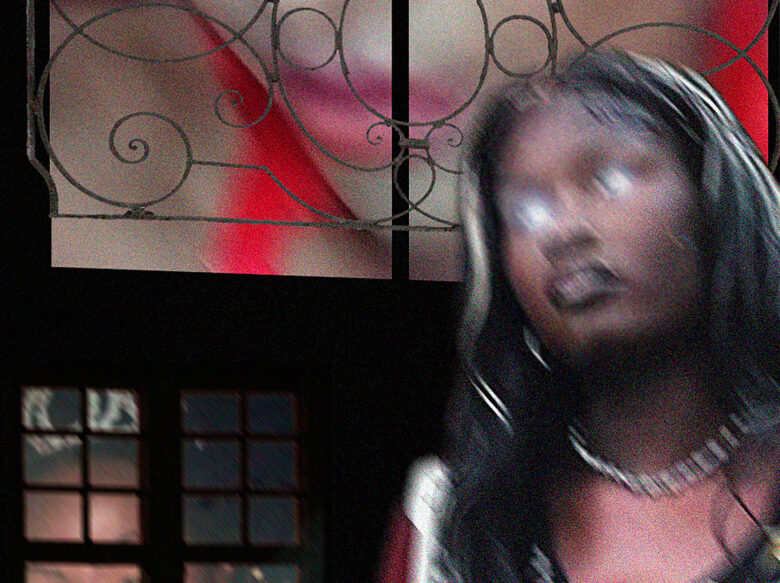
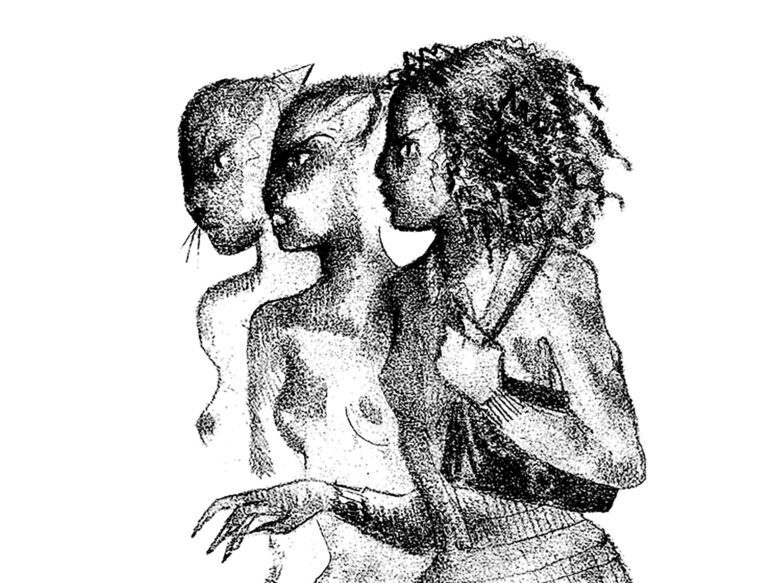
For the facade of Nørrebro Teater, Maty Biayenda translates her ongoing research around nightlife subcultures and forgotten histories into a compelling series of site-specific flags, and selected images for their aesthetic power and the stories they embody. The front surfaces display a powerful tapestry of resilience – anchoring legendary performers like Rita Ester and Moldavia, ballroom figures, and anonymous faces, to women who faced tragic violence, such as Jessica Sarmiento, a trans sex worker assassinated outside of Paris. On the reverse, fragmented imagery converges around a transformational figure from Biayenda’s current auto-fictional graphic novel Sphinge Endormie (The Sleeping Sphinx). Here, the chimera emerges as a metaphor for hybrid, intersectional identities – standing at the intersection of myth, pop culture, and intimate experience to offer a vibrant and re-enchanted narrative of survival and resistance
Maty Biayenda was born in Namibia to a French-Congolese family, and grew up in France where she lives and works. After completing a year of art preparation at the Ateliers de Sèvres, she graduated in textile and material design from Ecole Nationale Supérieur des Arts Décoratifs in Paris. Her multidisciplinary practice is regularly exhibited in France and internationally. Her monographic installation Le Caroussel was presented the Frac Île-de-France, Paris (2025), and has been included in institutional exhibitions at Palais de Tokyo, Paris (2025), Centre Pompidou, Paris (2025) at le19M, Paris (2025). She has also been awarded artist residencies at the Banff Center, Canada, and Villa Medicis in Rome, Italy.
Martha Kirszenbaum is a curator, writer and editor based in Paris. Her work has explored multidisciplinary and decompartmentalized approaches to curating art practices, bringing together visual arts, performance, dance, film and music. She graduated from Sciences-Po in Paris and Columbia University, was the curator of the French Pavilion of the 58th Venice Biennale represented by Laure Prouvost, and founded and directed Fahrenheit—an exhibition space and residency program in Los Angeles. She previously held positions at MoMA, New Museum and Centre Pompidou and has organized exhibitions, screenings, performances and talks at renowned international institutions. She is a regular contributor to numerous art publications, sits on the Editorial Board of CURA. Magazine, and teaches internationally.